How to scale your agency in the age of AI when your sales team doesn't understand what they're selling
Coral Wood • April 23, 2026
Week three of onboarding. Your newest rep is in a mock pitch when a prospect asks how they'd help a dental practice show up in ChatGPT. Your rep pauses, reaches for the Semrush tab, scrolls through a dashboard she half-understands, and recovers with something vague about "local signals."
You're watching from across the room. She's not a bad rep. She's a good rep who doesn't understand what she's selling yet, and on your current onboarding path, she might not understand it for another three months.
If that feels familiar, this is for you.
Selling SEO isn't what it used to be
If you're thinking about how to scale your agency, you might think you need to hire more salespeople, train them on Semrush or Ahrefs, and hope that they eventually sound half as convincing as you. If that's how you've always done it, or if you've quietly assumed it's the only way, there is another.
Search is no longer Google-only. AI Overviews now appear above most commercial queries. ChatGPT, Gemini and Perplexity recommend businesses directly, often without ever sending a click to a website. If you're selling "SEO" the same way you did in 2023, you're selling yesterday's product.
Clients know what they don't know. Local business owners, the ones who used to nod politely when you mentioned backlinks, are now asking pointed questions about AI visibility. "How do I show up when someone asks ChatGPT for the best plumber in Leeds?" is a real question real prospects are asking. If your rep can't answer it, the deal moves down the road.
The talent market has tightened. Great salespeople are scarce. Great salespeople who also understand digital marketing are rarer still. Meanwhile, the cost of onboarding a new hire across a dozen tools has quietly become one of the biggest line items in your growth budget.
The upshot? Scaling your agency in 2026 is less about adding capacity and more about removing the reasons your team still needs you on every call.
Why your sales team doesn't understand what they're selling (and why that's not their fault)
When agency owners complain that their sales team doesn't understand what they're selling, the instinct is to blame hiring or training. Usually, it's neither.
The real issue is that the products we sell (local SEO, AIO, GEO, performance content, digital presence management) don't live in a single story. They live scattered across four different dashboards, two Chrome extensions, and a PDF template nobody updates.
Your sales team doesn't need more training on more tools. They need one clear narrative where they can walk into any meeting and confidently build trust.
That narrative has three stages:
- Here's where your business shows up today, across Google, Maps, AI search, reviews, speed, and accessibility.
- Here's where your competitors are ahead of you.
- Here's what we'd do to close the gap.
If your sales team can deliver those three things in under ten minutes, inside the prospect's first call, you have a scalable sales motion.
"I currently sell media, but…" The hardest pivot in agency land
A quick detour, because this one comes up constantly.
If you currently sell media (print, radio, broadcast, directory listings, Yellow Pages) and you're trying to add digital and AI services, you already know this is the hardest pivot in the industry.
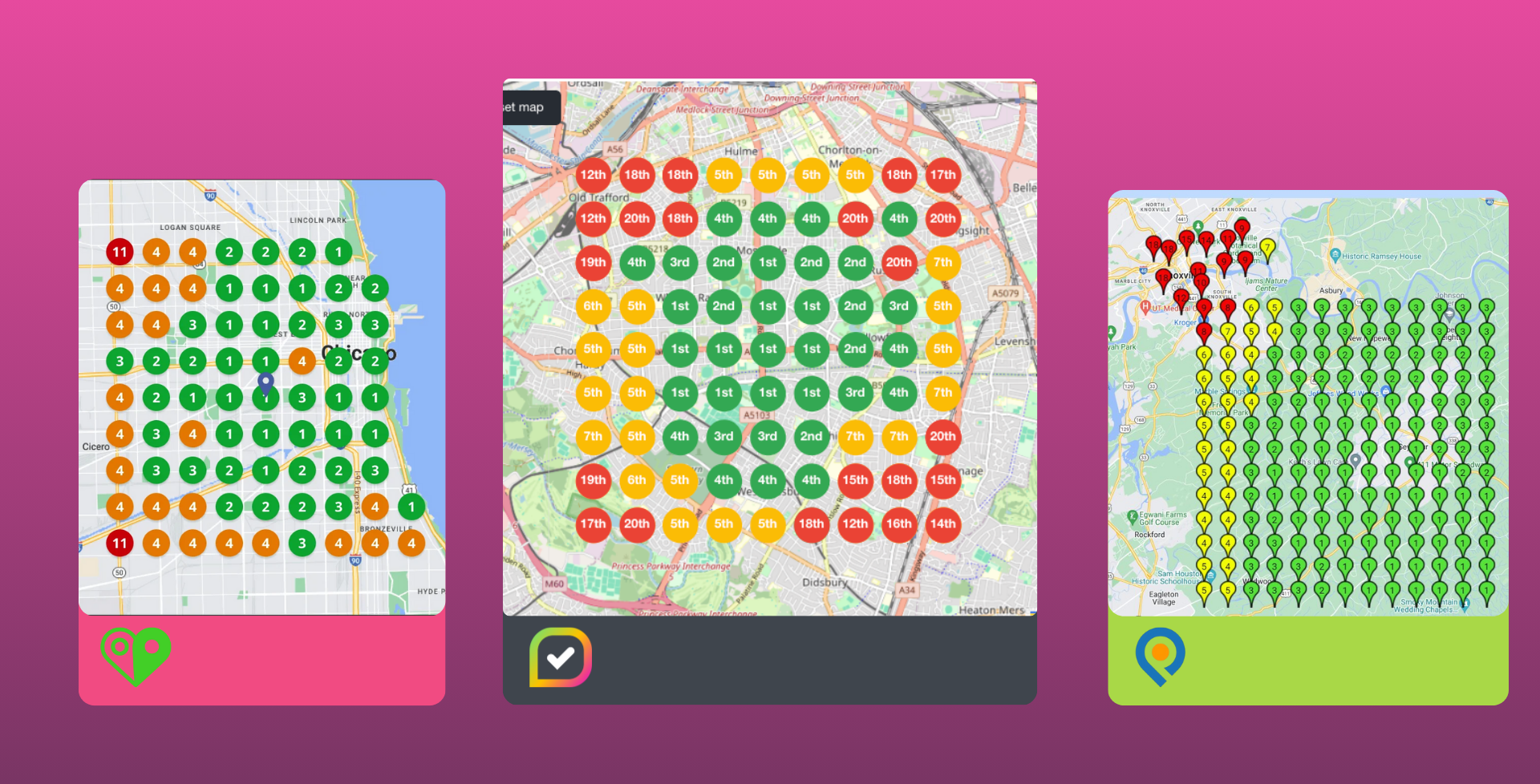
What we see work, again and again, is giving those reps a visual, colour-coded snapshot they can hand to a business owner in the first ten minutes of a meeting. Green means you're doing well here. Red means you're losing customers here. Yellow is where we'd start.
The pivot isn't about retraining sales teams into SEO analysts. It's about giving them a digital product that feels as concrete as the one they already know how to sell.
The five shifts that actually let you scale your sales at your agency
Here's what growing agencies are doing differently in 2026. Not all of it will apply. Pick the ones that match the bottleneck you're actually staring at.
1. Stop training reps on tools. Start giving them insight.
Semrush and Ahrefs are extraordinary products for practitioners. For a sales rep trying to explain to a dentist why their Google Business Profile is hurting them, they're overkill. Hundreds of features, most irrelevant to the conversation, all of them intimidating.
The agencies scaling fastest have replaced "tool training" with "insight delivery." Their reps don't navigate dashboards on live calls. They pull a single visual audit, walk the client through it, and let the report do 70% of the talking. Onboarding a new rep drops from three months to three days.
2. Lead every conversation with an audit, not a pitch.
This is the Gargle playbook, and it's the cleanest example we have of what scaling your sales at your agency actually looks like in practice. Gargle's team needed to grow without the traditional bottleneck of training every rep on complex SEO tools. They gave every rep the ability to run a full audit on a prospect's site before the first call, and to walk through colour-coded findings during it. As a result, Gargle doubled the size of their business using Insites.
3. Make AI visibility part of your core offer, today, not next quarter.
A year ago, "Can you help me rank in ChatGPT?" was a curious question. Today it's a buying question. If your agency doesn't have a clear, demonstrable answer, the one down the road does.
The practical move: add an AI visibility layer to your standard audit. Show the prospect exactly how ChatGPT, Gemini and Perplexity describe their business right now, or more often, how they don't.
4. Use AI to do the work that doesn't need a human.
Prospecting, list-building, first-touch emails, qualifying leads, summarising calls, drafting follow-ups. This is work agentic workflows now handle better than a junior BDR. Not because AI is smarter, but because it's relentless and free of the context-switching tax.
The leverage is pointing your sales team at the 20% of activities a human is still uniquely good at: building relationships, reading a room, and closing. Every hour you claw back from admin is an hour of pipeline.
5. Measure the thing that actually predicts scale.
Most agencies track activity: calls made, emails sent, demos booked. Those are input metrics, and they stop mattering the moment you're trying to scale.

The metric that matters is rep confidence. Or more precisely: the percentage of deals your reps close without needing you on the call. Track that number. Watch what happens when it moves from 20% to 60%. That's the moment your agency stops being a bottleneck and starts being a business.

The path forward for scaling your agency in 2026
Here's what growing agencies are doing differently in 2026. Not all of it will apply. Pick the ones that match the bottleneck you're actually staring at.
1. Stop training reps on tools. Start giving them insight.
Semrush and Ahrefs are extraordinary products for practitioners. For a sales rep trying to explain to a dentist why their Google Business Profile is hurting them, they're overkill. Hundreds of features, most irrelevant to the conversation, all of them intimidating.
The agencies scaling fastest have replaced "tool training" with "insight delivery." Their reps don't navigate dashboards on live calls. They pull a single visual audit, walk the client through it, and let the report do 70% of the talking. Onboarding a new rep drops from three months to three days.
2. Lead every conversation with an audit, not a pitch.
This is the Gargle playbook, and it's the cleanest example we have of what scaling your sales at your agency actually looks like in practice. Gargle's team needed to grow without the traditional bottleneck of training every rep on complex SEO tools. They gave every rep the ability to run a full audit on a prospect's site before the first call, and to walk through colour-coded findings during it. As a result, Gargle doubled the size of their business using Insites.
3. Make AI visibility part of your core offer, today, not next quarter.
A year ago, "Can you help me rank in ChatGPT?" was a curious question. Today it's a buying question. If your agency doesn't have a clear, demonstrable answer, the one down the road does.
The practical move: add an AI visibility layer to your standard audit. Show the prospect exactly how ChatGPT, Gemini and Perplexity describe their business right now, or more often, how they don't.
4. Use AI to do the work that doesn't need a human.
Prospecting, list-building, first-touch emails, qualifying leads, summarising calls, drafting follow-ups. This is work agentic workflows now handle better than a junior BDR. Not because AI is smarter, but because it's relentless and free of the context-switching tax.
The leverage is pointing your sales team at the 20% of activities a human is still uniquely good at: building relationships, reading a room, and closing. Every hour you claw back from admin is an hour of pipeline.
5. Measure the thing that actually predicts scale.
Most agencies track activity: calls made, emails sent, demos booked. Those are input metrics, and they stop mattering the moment you're trying to scale.

The metric that matters is rep confidence. Or more precisely: the percentage of deals your reps close without needing you on the call. Track that number. Watch what happens when it moves from 20% to 60%. That's the moment your agency stops being a bottleneck and starts being a business.