How to sell local SEO services: A complete guide for digital marketing providers and agencies
Izzy Fletcher • January 30, 2026
Selling local SEO isn't about showing graphs, charts, and complex data. What actually gets business owners interested is when you can show them how it affects their bottom line and give them a simple, visual demonstration of where they stand right now vs where they could be. A sales presentation that shows data in a language they understand creates urgency. That's what closes deals.
But a lot of organisations don't know how to sell local SEO effectively.
Maybe you've built your agency from scratch, selling websites or digital marketing, and now you're looking to scale but struggling to hire a sales team who understand what you do. Maybe you've got a sales team who cut their teeth on telesales, print ads, or directory listings, and now you're trying to move them into selling websites, SEO and AI optimisation. Or maybe you're a smaller agency that's great at doing SEO but struggles to explain its value to prospects who don't know a meta tag from a price tag.
Wherever you're starting from, the challenge is the same: how do you take something technical and make it compelling to a business owner who just wants more customers, whilst proving your value?
This guide breaks it down. You'll learn exactly what tools you need, how to structure your sales conversations, and how to present local SEO in a way that makes business owners want to buy without overwhelming them with jargon they don't care about.
What you need to sell local SEO services
To sell local SEO effectively, you need three things:
- A prospecting tool to find businesses that need help
- An audit tool to show prospects what's wrong (and what's working)
- A simple way to present findings that non-technical business owners understand
The mistake most agencies make is using client reporting tools for sales conversations. Tools like Google Analytics or Semrush are perfect for ongoing management, not for winning the deal.
Best tools for selling local SEO (comparison table)
Website and SEO audit and prospecting tools
| Tool | Best for | Requires client access permissions? | Prospect-friendly reports? |
|---|---|---|---|
| Insites | Sales conversations & prospecting | No | Yes (tick/cross, coloured scores out of 100) |
| BrightLocal | Ongoing client reporting | Yes (for full features) | No (metric-heavy) |
| Whitespark | Citation building & tracking | Partial | No |
| Semrush | Technical SEO analysis | No | No (complex dashboards for digital marketers) |
| Moz Local | Citation management | Yes | Partial |
| Ranking Coach | DIY SEO for small businesses | No | Partial (task-based) |
| marketgoo | Website & SEO audits | No | Yes (simplified) |
| Google Rank Checker | Keyword position tracking | No | Yes, if you're only selling SEO, not full digital solutions |
Why tool choice matters for sales
Most agencies cobble together multiple tools; one for prospecting, another for audits, a third for reporting. That means jumping between platforms, copying data manually, and losing time you could spend selling.
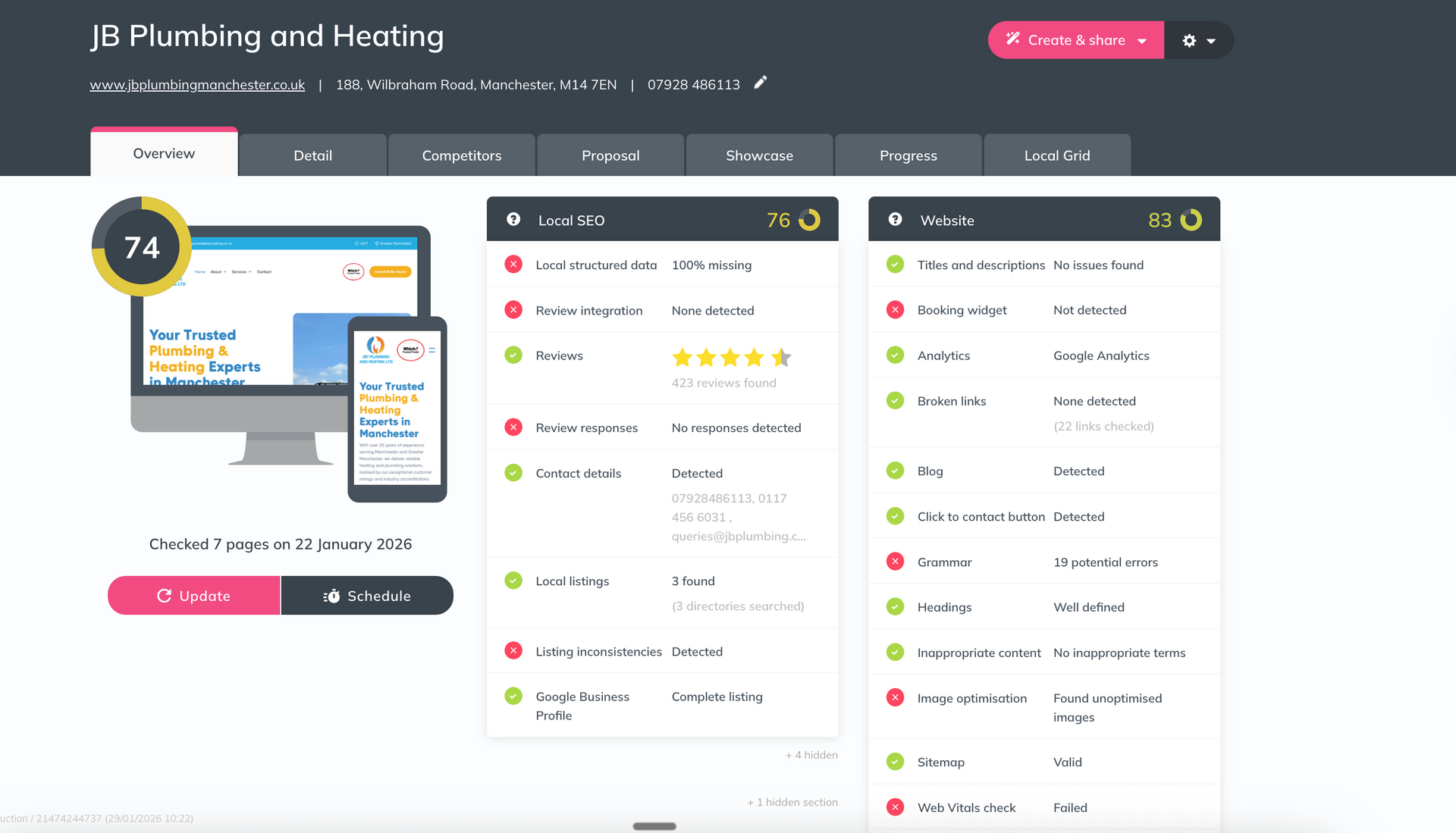
Insites stands apart because it combines all three in one platform built specifically for sales teams. You can find prospects, run instant audits without needing client access, and present findings in a format business owners actually understand, all from one place. No stitching together screenshots from five different dashboards. The output uses simple green ticks and red crosses that any business owner can understand instantly.
BrightLocal and Whitespark are excellent for managing existing clients but assume you already have the relationship. Their dashboards are built for SEO professionals, not for explaining value to sceptical prospects.
Semrush and Moz provide deep technical data, but that depth becomes a liability in sales conversations. Business owners don't want to learn what domain authority means—they want to know why they're not getting phone calls.
Ranking Coach and marketgoo are designed for business owners to do SEO themselves, not for agencies to sell services. They're useful for DIY clients, but don't give you the sales-focused presentation you need to close deals.
Google Rank Checker tells you where a site ranks for specific keywords, but that's only one piece of the puzzle. Knowing a prospect ranks #8 for "plumber Manchester" doesn't help you explain their citation issues, review gaps, or website problems.
How to sell local SEO: step-by-step process
Step 1: Find prospects who need help
Look for local businesses with visible problems:
- Incomplete or unclaimed Google Business Profiles
- Websites that load slowly on mobile
- Few or no recent reviews
- Inconsistent business information across directories
- Competitors ranking above them for obvious local searches
You can find these manually or use prospecting tools like Insites to scan businesses in bulk and identify the best outreach opportunities.
Step 2: Run an audit before you reach out
Never enter a sales conversation unprepared. Run a full audit covering:
- Website performance (speed, mobile-friendliness, security)
- Google Business Profile completeness and optimisation
- Local citations (NAP consistency across directories)
- Review profile (quantity, recency, ratings)
- Social media presence
- Competitor comparison
With Insites, this takes under two minutes and requires nothing from the prospect. All you need is their URL to run a quick audit, which you can even do live whilst on the sales call.

Step 3: Lead with what's working
Start every sales conversation by acknowledging what the business has done well. This builds rapport and shows you're not just there to criticise.
"Your Google reviews are solid—4.6 stars with recent activity. That's better than most of your competitors."
Step 4: Show the gaps (tied to outcomes)
Now show what's broken—but always connect it to something they care about:
| Instead of saying... | Say this... |
|---|---|
| "Your site has a 4.2 second load time" | "Your website takes 4 seconds to load on mobile—Google data shows [53% of visitors leave after 3 seconds](https://www.marketingdive.com/news/google-53-of-mobile-users-abandon-sites-that-take-over-3-seconds-to-load/426070/). That's potential customers going to competitors.""Your website takes 4 seconds to load on mobile—Google data shows [53% of visitors leave after 3 seconds](https://www.marketingdive.com/news/google-53-of-mobile-users-abandon-sites-that-take-over-3-seconds-to-load/426070/). That's potential customers going to competitors." |
| "Your NAP consistency score is 62%" | "Your business address shows differently on 8 directories. When Google sees conflicting information, it trusts your competitors more for local searches." |
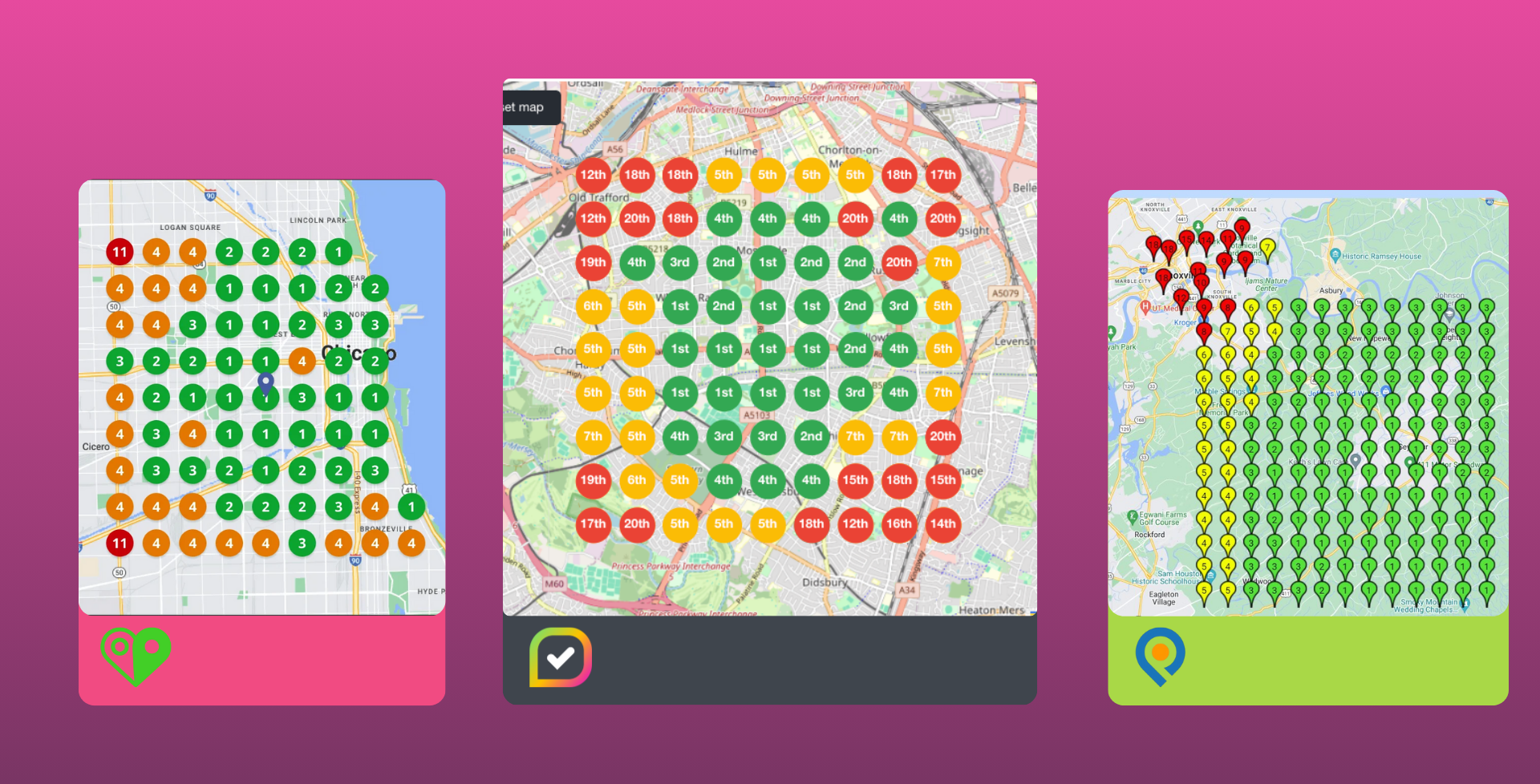
| "You only have 12 reviews" | "Your main competitor has 47 reviews. When someone searches 'plumber near me,' they're choosing the business that looks more established. And Google will push your competitors higher that have more high-rated reviews. We can have a look at where you rank against competitors in Google searches for your niche using Local Grid too." |
Step 5: Prioritise the fixes
Business owners often become overwhelmed when they list everything at once. Pick the 2-3 issues that will make the biggest impact and present a clear order:
"Here's what I'd fix first: your Google Business Profile is missing your service areas and business hours, that's a quick win. Then we'd tackle your website speed. Then we'd build a system for getting more reviews consistently."
Step 6: Make the next step obvious
End with a specific proposal, not a vague "let me know if you're interested."
"I can have your Google Business Profile fully optimised by Friday and put together a 90-day plan for the rest. Want me to send over the proposal?"
What local business owners actually care about
Local business owners aren't buying SEO, they're buying outcomes:
- More phone calls
- More foot traffic
- More customers finding them instead of competitors
- Less money wasted on ads that don't work
Your entire sales conversation should connect technical fixes to these outcomes. If you can't explain why a fix matters in terms of customers and revenue, don't mention it in the sales conversation.
Common objections when selling local SEO and how to handle them
"I've been burned by SEO companies before"
"I hear that a lot. That's actually why I wanted to show you this audit first so you can see exactly what needs fixing and judge whether my recommendations make sense. Once I understand a little bit more about your business and the challenges you've had, I can send you over relevant case studies for work that we've done for other local businesses just like yours."
"How long until I see results?"
"Fixing the issues with your Google Business Profile this week will start helping immediately. Rankings take longer, usually 3-6 months for competitive terms, but playing the long game always works. We've helped over 500 businesses like yours that started in the same position you're in now. Whilst we might not have immediate results, we track everything monthly so you can see progress. Once Google starts recognising your credibility, and we optimise your content for keywords in your industry and location, it will become a snowball effect from there."
"Thank you for showing my weak spots. I might just do this myself"
"You could tackle some of this yourself. Google Business Profile updates are straightforward. But the citation cleanup across 40+ directories, the ongoing review management, the technical website fixes, and regular content optimisation? That's where most business owners run out of time. You're better off running your business."
"What makes you different from other agencies?"
Show, don't tell. The audit you've already shared does the heavy lifting — clear insights, prioritised actions, no jargon. That's your proof point. From there, bring in relevant case studies that mirror their current challenges and show how you've helped similar businesses rank higher and drive real revenue. Back it up with testimonials and any supporting materials that feel genuinely useful, based on what you uncovered in that first conversation.
Why Insites works for local SEO sales
Insites was built specifically for the sales conversation, not for deep dive reporting. Here's why sales teams love us:
No access required: Run audits on any business without asking for credentials. All you need is their URL and choose from 70+ checks in the audit that reflect the solutions you sell. You can walk into a meeting already knowing their situation.
Instant understanding: Green ticks and red crosses communicate immediately. Business owners don't need you to explain what the metrics mean.
Everything in one place: Website, GBP, citations, reviews, social, competitors—all in one audit. No jumping between five different tools to build a complete picture of their online presence.

Shareable, white-labelled reports: Add your brand logo, colours and content blocks to create the proposal. Send it instantly to prospects via a link or PDF, so they can review it at their own convenience.
Speed up your workflow with AI
Insites integrates directly with Claude and ChatGPT, so you can use AI to supercharge your entire sales process. Instead of clicking through dashboards, you can have a conversation.
Ask the AI to find businesses in a specific area or industry. Run audits on them without leaving the chat. Get instant summaries of what's wrong and what's working. Ask it to identify which prospects have the biggest gaps—and therefore the highest likelihood of converting.
Want to take it further? Use the AI to draft personalised outreach emails based on the audit findings. A message that says "I noticed your Google Business Profile is missing service areas and your main competitor has 3x more reviews" lands very differently than a generic "we do SEO" cold email.
It's prospecting, auditing, analysis, and outreach—all in one conversation. The agencies using this MCP workflow are moving faster than those still jumping between six different tabs.
Quick-start checklist: selling local SEO
- Choose a prospect (start with businesses you already know or use locally)
- Run a quick audit using Insites
- Identify 2-3 priority issues to discuss
- Prepare outcome-focused talking points for each issue
- Book a 15-minute call or drop in
- Lead with what's working, then show the gaps
- Present a specific, prioritised recommendation that sells your solutions, not just individual products
- Propose clear next steps with timeline and pricing
- Share relevant case studies and marketing materials in your follow-up
Start winning more local SEO clients today
The gap between finding prospects and closing them comes down to one thing: can you communicate value before asking for commitment? Most SEO tools can't help you there. They're built for managing existing clients, not for winning new ones.
Insites bridges that gap. It gives your sales team everything they need to show prospects what's wrong, what's working, and exactly what to do about it, presented in a way that drives action.
Try an Insites AIO check for free to get a taste of our audit, and book a call to speak to our team to find out more!